
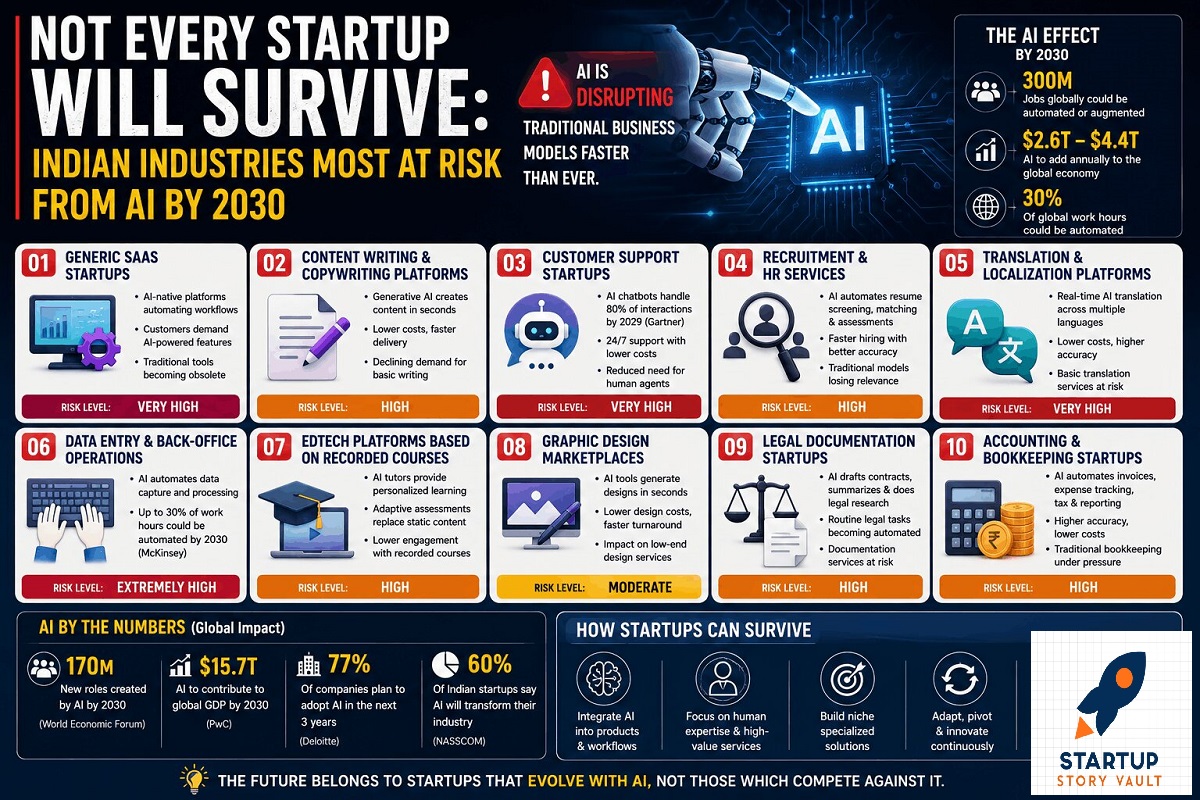
Artificial Intelligence (AI) is expected to add between $2.6 trillion and $4.4 trillion annually to the global economy, according to McKinsey. While AI is creating new opportunities, it is also disrupting traditional business models. By 2030, several Indian startup sectors may face significant pressure as automation and Generative AI become mainstream.
Here are some startup segments that could struggle unless they adapt to AI-driven changes.
1. Generic SaaS Startups
India’s SaaS market is projected to generate $50 billion in revenue by 2030, according to Bain & Company. However, AI-native software companies are rapidly changing customer expectations.
Why They May Struggle
- AI agents can automate workflows.
- Customers increasingly demand AI-powered features.
- Global competitors are integrating GenAI into products.
- Traditional software solutions are becoming commoditized.
Biggest Risk
Companies offering basic CRM, project management, and analytics tools without AI capabilities may lose relevance.
2. Content Writing and Copywriting Platforms
Generative AI tools such as ChatGPT, Gemini, Claude, and Perplexity are transforming content creation.
According to Goldman Sachs, AI could automate tasks equivalent to 300 million full-time jobs globally.
Challenges
- Faster content production.
- Lower costs for businesses.
- Reduced demand for simple blog writing.
- Increased competition from AI tools.
Likely Winners
Platforms focused on premium research, human creativity, and specialized content.
3. Customer Support Startups
Gartner predicts that AI-powered systems will manage nearly 80% of customer interactions by 2029.
AI Advantages
- 24/7 support.
- Faster response times.
- Lower operational costs.
- Improved scalability.
Sectors at Risk
- Traditional BPO startups.
- Call-center-based customer support firms.
- Manual ticketing platforms.
4. Recruitment and HR Services
The global AI recruitment market is expected to exceed $1.1 billion by 2030.
AI can already perform:
- Resume screening.
- Candidate matching.
- Interview scheduling.
- Skill assessments.
Why Traditional Recruiters May Face Pressure
- Reduced hiring time.
- Lower recruitment costs.
- Better candidate analysis.
Human recruiters will still be valuable, but repetitive hiring processes are becoming increasingly automated.
5. Translation and Localization Startups
Large Language Models are making multilingual communication easier than ever.
Major Challenges
- Real-time translation.
- Voice-to-text capabilities.
- Support for dozens of languages.
According to CSA Research, machine translation adoption is increasing rapidly among enterprises worldwide.
Biggest Threat
Basic translation services may become highly commoditized by 2030.
6. Data Entry and Back-Office Operations
McKinsey estimates that up to 30% of global work hours could be automated by 2030.
AI Can Handle
- Invoice processing.
- Form filling.
- Document classification.
- Data extraction.
Risk Level: Extremely High
Labor-intensive startups that depend on repetitive tasks may struggle to maintain profitability.
7. EdTech Platforms Based on Recorded Courses
India’s EdTech sector experienced explosive growth during the pandemic. However, AI tutors are changing the landscape.
AI Advantages
- Personalized learning.
- Instant doubt resolution.
- Adaptive assessments.
- 24/7 accessibility.
According to HolonIQ, AI-powered education technologies are expected to become mainstream by the end of the decade.
Future Winners
- Live mentorship platforms.
- Skill-based education.
- Career-focused learning.
8. Graphic Design Marketplaces
Generative AI tools such as Midjourney and DALL-E can create images within seconds.
Challenges
- Lower design costs.
- Faster production.
- Increased automation.
What Will Survive?
High-end branding, creative strategy, and premium design agencies are likely to remain relevant.
9. Legal Documentation Startups
AI-powered legal assistants are automating many routine tasks.
AI Applications
- Contract drafting.
- Compliance reviews.
- Legal summaries.
- Research assistance.
According to Thomson Reuters, legal AI adoption is accelerating among law firms and enterprises.
Risk
Startups focused only on documentation services may struggle against AI-driven platforms.
10. Accounting and Bookkeeping Startups
Artificial intelligence is increasingly automating financial operations.
AI Can Perform
- Invoice generation.
- Expense tracking.
- Tax calculations.
- Financial reporting.
According to PwC, automation will significantly transform accounting functions over the next decade.
Comparison Table
| Startup Segment | AI Disruption Level |
|---|---|
| Generic SaaS | Very High |
| Content Platforms | High |
| Customer Support | Very High |
| Recruitment Services | High |
| Translation Platforms | Very High |
| Data Entry Services | Extremely High |
| Recorded-Course EdTech | High |
| Graphic Design Marketplaces | Moderate |
| Legal Documentation | High |
| Accounting Startups | High |
Why Adaptation Is Critical
A report by the World Economic Forum estimates that while AI may eliminate 92 million jobs globally by 2030, it could also create 170 million new roles, resulting in a net gain of 78 million jobs.
The same principle applies to startups. AI will not destroy industries entirely—it will reward companies that evolve.
Conclusion
By 2030, India’s startup ecosystem will look very different. Sectors built around repetitive, rules-based, and easily automated tasks face the greatest risk from AI disruption. Startups that fail to integrate Generative AI, automation, and human expertise into their business models may struggle to remain competitive.
The winners of the AI era will not be those that compete against artificial intelligence—but those that learn how to work alongside it.