
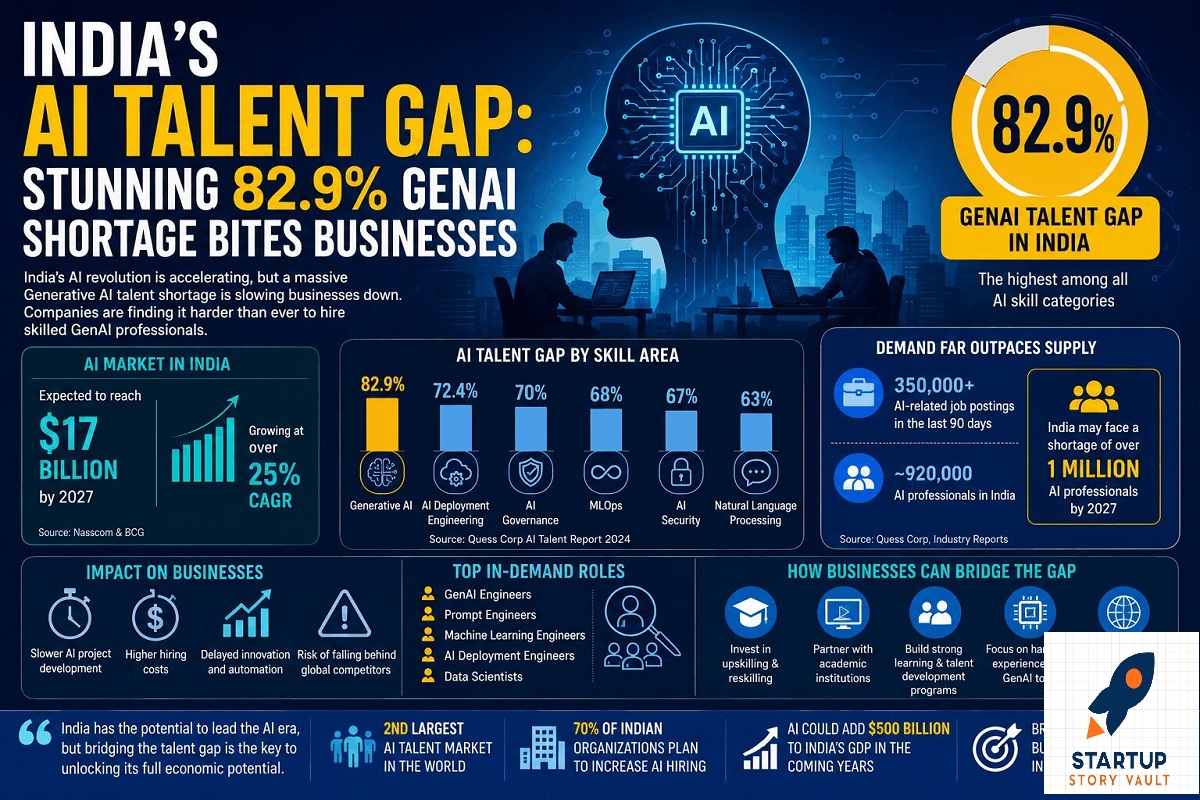
India is rapidly emerging as one of the world’s largest artificial intelligence (AI) markets, but a severe shortage of Generative AI (GenAI) professionals is becoming a major challenge for companies. According to recent industry reports, India faces an 82.9% shortage of GenAI talent, creating a significant gap between demand and the availability of skilled professionals.
As businesses accelerate their AI adoption plans, finding qualified talent has become one of the biggest hurdles to growth.
Key Highlights
- India faces an 82.9% shortage of Generative AI talent.
- Demand for AI professionals is rising faster than the supply of skilled workers.
- Companies across sectors are investing heavily in AI technologies.
- AI-related salaries have increased significantly due to talent scarcity.
- Upskilling and training programs are becoming critical for businesses.
AI Adoption Is Growing Rapidly
Artificial intelligence is no longer limited to technology companies. Industries such as:
- Banking and financial services
- Healthcare
- Retail and e-commerce
- Manufacturing
- Education
- Telecommunications
are increasingly using AI tools to improve efficiency and customer experience.
According to estimates by Nasscom and BCG, India’s AI market is expected to reach $17 billion by 2027, growing at an annual rate of over 25%.
Why Is There Such a Huge Talent Gap?
1. Explosive Demand for GenAI Skills
The launch of tools like ChatGPT, Gemini, and Copilot has accelerated AI adoption worldwide. Organizations are now seeking experts in:
- Large Language Models (LLMs)
- Prompt engineering
- Machine learning
- Natural language processing
- AI automation
- Data science
However, the supply of professionals with these skills remains limited.
2. Traditional Education Is Lagging
Many colleges and universities are still updating their curriculum. As a result, graduates often lack hands-on experience with advanced AI technologies.
Industry experts estimate that only a small percentage of engineering graduates possess job-ready AI skills.
3. Global Competition for Talent
Indian AI engineers are increasingly being recruited by multinational companies and overseas startups. Higher salaries and remote work opportunities have intensified competition for skilled professionals.
Rising Salaries in AI
The shortage has pushed compensation levels higher.
According to TeamLease Digital and other industry reports:
| Role | Average Annual Salary |
|---|---|
| AI Engineer | ₹15-35 lakh |
| Data Scientist | ₹12-30 lakh |
| Machine Learning Engineer | ₹18-40 lakh |
| Prompt Engineer | ₹10-25 lakh |
| GenAI Specialist | ₹20-50 lakh |
Experienced professionals can command even higher salaries.
Which Industries Are Hiring AI Talent?
Technology
Software companies are integrating AI into products and services.
Banking and Finance
Banks are using AI for fraud detection, customer service, and risk management.
Healthcare
Hospitals and health-tech firms are adopting AI for diagnostics and personalized care.
Retail and E-commerce
AI-powered recommendations and customer analytics are becoming increasingly important.
Manufacturing
Companies are using automation and predictive maintenance systems to improve productivity.
Companies Are Focusing on Upskilling
To address the talent shortage, organizations are investing heavily in employee training programs.
Popular areas of upskilling include:
- Prompt engineering
- Python programming
- Generative AI tools
- Data analytics
- Cloud computing
- Machine learning frameworks
Major companies such as Infosys, TCS, Wipro, Accenture, and IBM have launched large-scale AI training initiatives for their employees.
Government Support Is Increasing
The Indian government has launched several initiatives to strengthen AI capabilities, including:
- IndiaAI Mission
- Digital India programs
- Semiconductor initiatives
- AI research funding
- Skill development schemes
The government aims to position India as a global AI hub over the coming decade.
Economic Impact of AI
According to PwC, artificial intelligence could contribute nearly $15.7 trillion to the global economy by 2030, while India alone could add approximately $500 billion to its GDP through AI-driven growth.
This makes addressing the talent gap essential for maintaining competitiveness.
Challenges Ahead
Despite strong growth prospects, companies face several challenges:
- Limited availability of skilled professionals.
- High hiring costs.
- Rapidly evolving technologies.
- Need for continuous learning.
- Increasing global competition.
The Road Ahead
Experts believe India can turn this challenge into an opportunity through:
- Industry-academia collaboration.
- AI-focused curriculum updates.
- Corporate training programs.
- Online certification platforms.
- Government-backed skill initiatives.
Conclusion
India’s 82.9% Generative AI talent shortage highlights a critical challenge for the country’s digital economy. While AI adoption is accelerating across industries, the supply of qualified professionals has not kept pace.
Businesses that invest in reskilling, education, and AI talent development will be better positioned to benefit from the next wave of technological innovation. As AI reshapes industries, bridging the talent gap will be essential for India to realize its ambition of becoming a global leader in artificial intelligence.